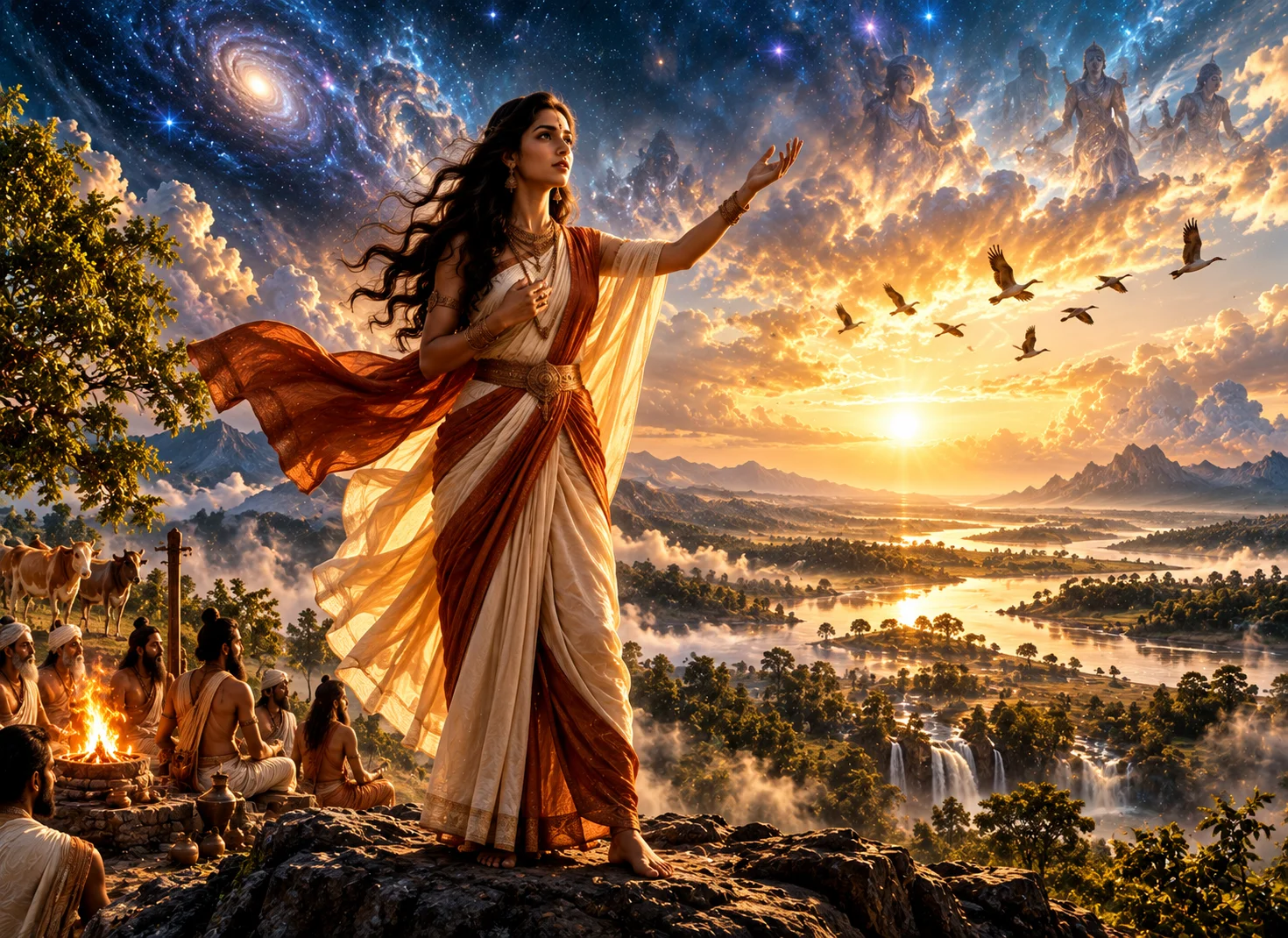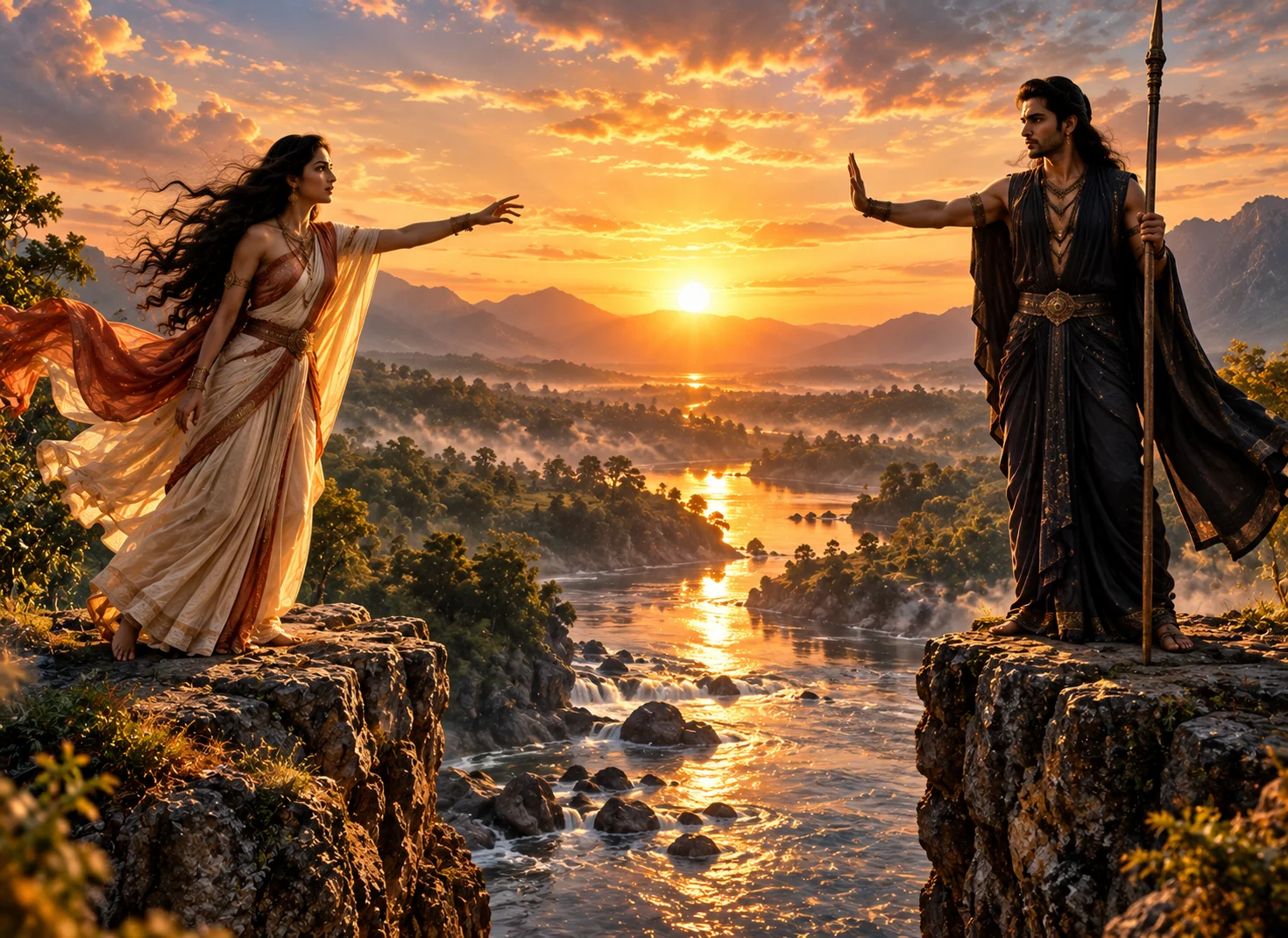
Before there was a mountain, there had been no stone. Before there was a river, there had been no water. Before there was fire, there had been no flame waiting to be struck. There had been no earth beneath the feet of anyone, because there were no feet; no sky above anyone, because there was no above; no wind, because there was nothing through which wind might move. There had been no morning and no evening, no distance to cross and no direction in which to travel. There was no death, but neither was there immortality, because there was no life by which either could be understood. The poet who tried to imagine that beginning found himself standing at the edge of a thought that seemed to have no edge. He could picture mountains disappearing into darkness, oceans drying into empty beds, stars collapsing into silence and generations of human beings becoming dust, because all those things belonged to a world he knew. But when he tried to imagine what came before the first thing existed, even imagination began to fail him.
That night, beside a small forest fire, Dirghatamas found himself no closer to an answer. The day had been spent in the ordinary work of the sacrificial ground: wood gathered, vessels washed, chants repeated until the sounds became as familiar as breathing. His young disciple Kutsaputra had finished preparing the morning offerings, yet neither man had gone to sleep. The fire had fallen to a bed of red embers, and the river beyond the trees could be heard moving over stone. Kutsaputra watched his teacher turn a dry stick through the ash. He had learned not to interrupt such silences too quickly, but curiosity finally overcame caution.
“The light is dying, Master,” he said. “Shall I bring more wood?” Dirghatamas looked at the ember rather than at the boy. “Leave it.” Kutsaputra waited, expecting an explanation, but none came. After a moment he asked whether the fire had taught his teacher something. The old man gave a faint smile. “It has taught me that we become confident about beginnings only after we have forgotten how little we saw.” Kutsaputra glanced at the darkness beyond the clearing and asked what he meant. Dirghatamas tapped the stick against the hearth. “Tell me what you call the place where the flame is no longer.”
“Darkness,” Kutsaputra answered. “The absence of light.” Dirghatamas looked at him then. “And how do you know it is darkness?” The boy frowned. “Because I can see that the fire is gone.” “Exactly. You have named it by what came before it.” Kutsaputra began to object, but the old man continued quietly. If the first thing had not yet appeared, what would darkness have meant? If there had been no light, no earth, no sky and no eye to see them, what could a man possibly call the state that preceded all of them? The question unsettled the boy because every answer he reached for depended upon something that was supposed to come later.
Kutsaputra drew the edge of his cloth over his knees and stared at the dying hearth. “Then the question cannot be answered,” he said. Dirghatamas shook his head. “That is too quick. A question does not become useless merely because the first answer fails.” The boy looked toward the dark trees. “The hymns say the gods made order from what was before. They separated earth from sky, opened the paths of the rivers and set the sun upon its course. Surely they know where the order began.” Dirghatamas turned the stick slowly between his fingers. “They know the world as we know it. But if the gods belong to the world that was made, who stood before the making?” Kutsaputra opened his mouth and stopped. He had expected the question to have an obvious answer. Instead, it had moved one step farther away.
“The gods have always existed,” he said finally. “Always?” Dirghatamas repeated. “Then you have given them a word that belongs to time without asking whether time existed.” Kutsaputra frowned. “If there was no time, how could anything happen?” “Perhaps that is the difficulty,” the old man said. “We speak of creation as though there must have been a moment when it began, but the word moment already assumes a world in which moments can pass.” The boy was silent. He had spent years learning to distinguish one ritual act from another by sequence: this chant before that offering, this gesture before the next. Now his teacher was asking him to imagine a condition in which sequence itself had not yet acquired meaning. “Then there was nothing,” Kutsaputra said. Dirghatamas gave a quiet laugh. “You have managed to smuggle a conclusion into the question.”
“How?” Kutsaputra demanded. “If there was no thing, there was nothing.” “And what do you mean by nothing?” “The absence of everything.” “Everything that you know,” Dirghatamas replied. “That is different.” He leaned forward and drew a line through the ash. “When you say there was nothing, your mind sees an empty place. You imagine darkness where a world might later stand. You have already supplied space, and you have already supplied the possibility of a world. You have not imagined nothing. You have imagined a world waiting to be filled.” Kutsaputra stared at the line. “Then what am I supposed to imagine?” “Perhaps nothing,” said the old man, “because perhaps the mind has reached the place where imagining itself becomes unreliable.”
The answer irritated Kutsaputra more than any argument would have done. “You speak as though ignorance were wisdom.” Dirghatamas smiled. “Sometimes ignorance honestly admitted is wiser than certainty invented to make it disappear.” The boy shifted closer to the hearth. “Then what of desire? The seers speak of desire arising before the distinction between being and non-being was complete. If desire was the first movement, what caused it?” “That is the question.” “Who desired?” “You are already looking for a person.” “Because desire belongs to someone.” Dirghatamas considered this. “Does every movement require a hand to push it? A seed begins to stir beneath the soil long before it becomes the tree you recognize. Perhaps desire was not a person’s wish. Perhaps it was the first inclination toward becoming.” Kutsaputra shook his head. “That sounds like giving a name to what you cannot explain.” “It may be,” the old man said. “And if so, we should have the honesty to say that as well.”
The fire gave a small crack and sent a brief red spark upward. Kutsaputra watched it disappear. “Suppose there was a first cause,” he said. “What caused that?” “And what caused the cause?” Dirghatamas asked. “Yes.” “And what caused the thing that caused it?” The boy smiled despite himself. “You are making fun of me.” “No. I am showing you what the mind does when it refuses to stop. It follows a river toward its source, then asks where the spring came from. It follows a lineage from father to grandfather and keeps asking for another name. It watches a fire begin with a spark and then asks where the spark came from. There is nothing wrong with following the chain. The trouble begins when we pretend that the place where our knowledge ends is the place where reality itself must end.” Kutsaputra lowered his eyes. The distinction was small in words and enormous in consequence.
He was quiet for some time before asking, “Then does anyone know?” Dirghatamas did not answer immediately. The forest had become almost completely still. Somewhere beyond the trees, the river continued its unseen course. “Perhaps,” he said at last. “Perhaps there is a witness who saw the first arising. Perhaps the highest one knows.” Kutsaputra looked up. “Then there is an answer.” “Perhaps.” “You do not sound convinced.” “Because another possibility remains.” The boy waited. Dirghatamas rested the stick across his knees. “What if even the highest witness did not see a beginning? What if the mystery is older than the witness we have imagined?” Kutsaputra stared at him. “Then no one knows.” “Perhaps no one does. Or perhaps someone does. The hymn does not force us to choose.” The old man’s voice had lost its earlier certainty, and that, more than any argument, made the boy listen.
Kutsaputra had expected wisdom to feel like possession. His teachers had always spoken of knowledge as something that could be acquired, remembered and passed from one generation to another. Yet the night was taking him somewhere else. He said that if the question could not be settled, there was a danger that every answer would become equally possible. Dirghatamas nodded. “That danger is real. Doubt is not automatically wisdom. A man can be uncertain because he has understood the limits of knowledge, or because he has never bothered to learn what can be known. The difference matters.” Kutsaputra looked at the ash between them. “Then what should I carry from this night?” “Carry the question,” the old man said. “And carry the discipline to distinguish what you have seen from what you have merely imagined.”
The words stayed with Kutsaputra after the conversation ended. He had begun the night believing that a teacher’s task was to replace uncertainty with answers. Now he saw that a teacher could also lead a student to the edge of an answer and refuse to pretend that the edge was a door. The forest seemed larger than it had before. The absence of explanation no longer made it empty. The river did not need to reveal its first drop in order to flow. The stars did not become less real because no one in the clearing could say who had first set them in place. He understood, dimly, that the question itself had changed him. He had arrived wanting to know what came before creation; he would leave knowing that even the word before might belong only to the created world.
A pale line appeared behind the eastern trees. Dirghatamas reached toward the hearth and touched the ash with two fingers. The fire was cold. “The sun will rise soon,” Kutsaputra said. “Yes.” “Will we speak of this again?” “If the question returns.” The boy smiled. “I think it will.” Dirghatamas stood, slowly straightening his back after the long night. “Then let it return. There is no shame in being asked twice by the same question.” Kutsaputra lifted the water vessel and started toward the river, then turned once more. “Master, if the highest witness knows the answer, would the question still matter?” Dirghatamas looked toward the paling horizon. “To the one who knows, perhaps not. To the one who seeks, it may be the beginning of wisdom.”
Sutra
The deepest wisdom begins when the mind becomes brave enough to leave a question unanswered.