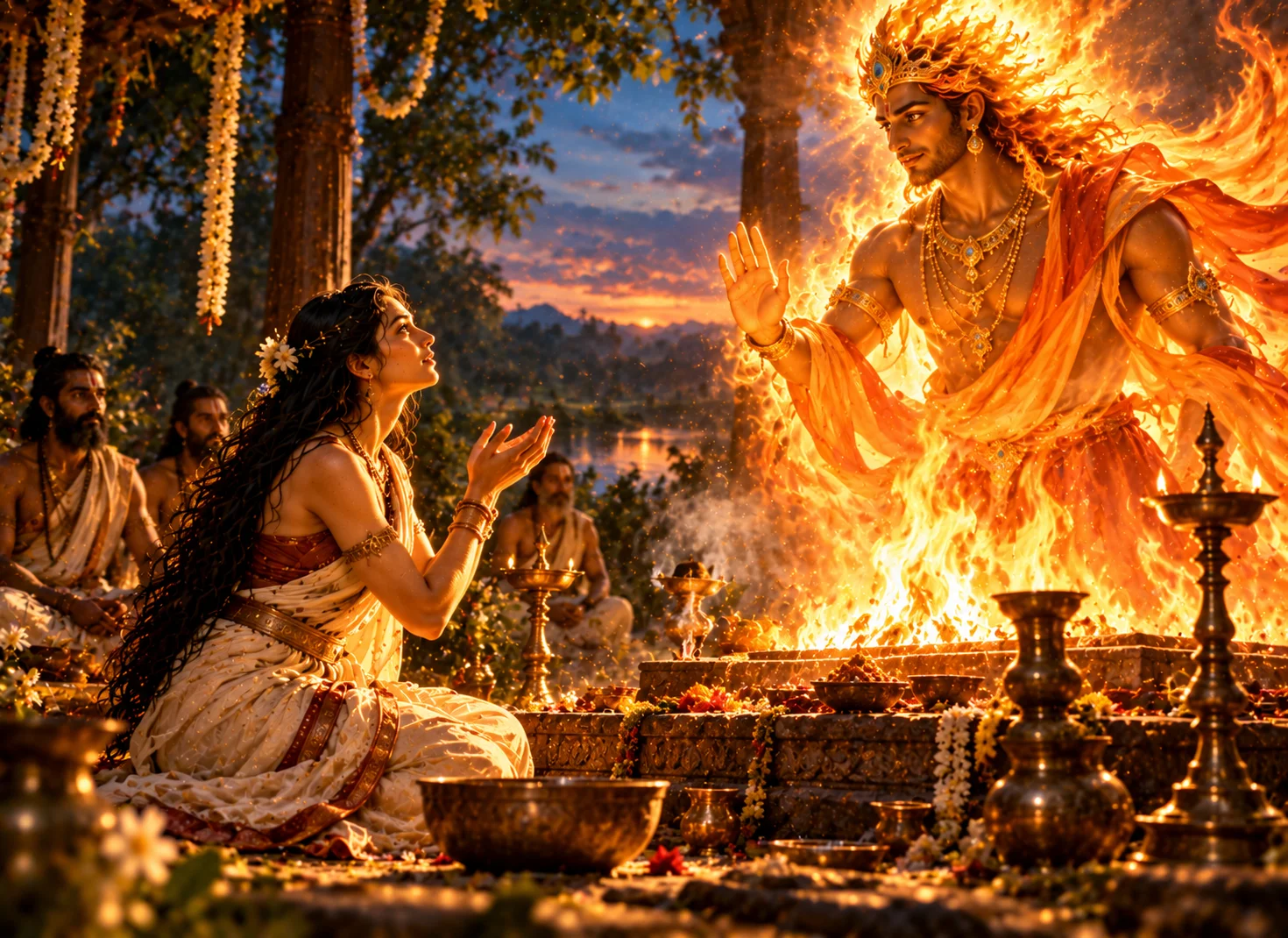
Before the sun appeared, Viśvavārā was already awake. The sacrificial ground lay beneath a sky still dark enough to hide the distant hills, and the household moved through the last preparations with the quiet concentration of people who knew that a ritual could fail through carelessness long before anyone noticed the failure. Wood had been gathered and split. The vessels had been washed. The altar had been cleared of yesterday’s ash. An older attendant checked the fuel twice, then looked toward Viśvavārā as though expecting her to find some fault he had missed. She only nodded. There was nothing more to arrange. The waiting itself had become part of the rite.
She stood before the unlit altar and listened to the sounds around her: the scrape of wood against stone, the soft movement of vessels being set in their places, a cough from someone who had risen too early, and beyond all of it the immense stillness of the dark. She had seen fire since childhood. Fire cooked food, warmed bodies, frightened animals from the night and reduced wood to ash. Yet the fire of the offering seemed to belong to another order. People approached it as a messenger, something that could carry what human beings gave beyond the reach of their hands. Viśvavārā had never been entirely certain what such a claim meant, but she had learned not to dismiss a mystery simply because it could not be held in the hand.
The first flame caught reluctantly. It was small enough to protect with one curved palm, and the attendant leaned toward it before Viśvavārā stopped him with a gesture. “Let it breathe,” she said. He withdrew his hand, and for a few moments the fire trembled in the morning air as though deciding whether it wished to live. Then it straightened. Smoke rose. A few sparks escaped into the darkness and vanished. Viśvavārā watched the transformation with a concentration that surprised even her. The flame was changing from one instant to the next, yet everyone continued to call it by the same name. She wondered whether that was what made fire sacred: not that it remained unchanged, but that it could change completely and still be recognized.
When she began the invocation, Agni was no longer merely the flame before her. He was addressed as king, household lord and bearer of the offering, an ancient presence intimate enough to live beside human beings and immense enough to be imagined as reaching toward the gods. The words belonged to a tradition older than any one person who spoke them. Viśvavārā knew that she could kindle the fire, place the offering within it and speak the names handed down to her, but she could not command what the offering would become. That limit had always interested her. Human beings were skilled at preparing, arranging and naming; fire reminded them that transformation began where control ended.
She began the invocation again, more slowly this time, and the sound of her own voice altered the space around the altar. One of the younger attendants looked toward her, perhaps because he had expected the prayer to be louder. “Is the fire listening?” he asked when there was a pause. Viśvavārā looked at him. He was young enough to ask without embarrassment and old enough to have begun noticing that adults often spoke with certainty about things they could not explain. “I do not know,” she said. “But if we speak only when we are certain, there will be very little worth saying.” The boy lowered his eyes toward the flame, and she saw that he was considering the answer rather than merely accepting it.
She placed the first offering into the fire. For an instant the flame rose sharply, and the scent of the oblation moved upward with the smoke. The boy watched it disappear. “Where does it go?” he asked. Another attendant gave a small laugh, but Viśvavārā did not. “Into the fire first,” she answered. “After that, we can say only what we believe.” She watched the boy’s face. He seemed dissatisfied. That, she thought, was not necessarily a bad thing. A ritual that left no room for uncertainty could become only a performance, repeated perfectly and understood not at all.
Viśvavārā had often wondered whether this was why fire unsettled her. It accepted everything without becoming identical to anything. Grain entered it and became light; wood entered it and became heat and smoke; ghee vanished from sight while its fragrance spread through the air. The offering disappeared, but disappearance was not the same as destruction. Something had crossed a boundary. She could not point to the place where it had gone, yet she could see that the world around the altar had changed because it had been given. Perhaps a human life was like that as well. Perhaps what mattered was not only what a person possessed, but what the person allowed to become possible through what was given away.
The first light of dawn touched the eastern horizon. The sacrificial fire remained distinct from the coming sun, yet Viśvavārā felt that the two forms of brightness belonged to a single mystery. One arrived without asking anything of human beings. The other existed because human hands had gathered wood, guarded an ember and fed a flame. She had once thought of the ritual fire as an imitation of the sun, a smaller brightness made by people who lived beneath the greater one. Now she wondered if the relationship was more intimate. Perhaps the human flame did not imitate the sun at all. Perhaps it answered it.
The attendant returned with another piece of wood. “Should I feed it now?” he asked. Viśvavārā looked at the flame before answering. “Not yet.” He hesitated. “But it will weaken.” “Then we will learn whether it needs more wood or whether we are simply afraid to see it diminish.” The man smiled despite himself and waited. The fire bent low, recovered, and settled into a steadier burn. Nothing dramatic had happened. Yet Viśvavārā felt the lesson in the ordinary event. Human beings often interfered with change because they mistook continuity for safety. Fire required attention, but attention was not the same as control.
Around her, the ritual continued. Voices rose and fell. Vessels passed from one pair of hands to another. Someone corrected the placement of an offering and quietly apologized. The morning was becoming less mysterious with every minute, yet the fire remained strangely apart from the growing daylight. Viśvavārā thought about the generations that would come after them. They would not know her face. They might not remember the exact words she had spoken that morning. They would light fires with other hands and praise Agni with other voices. What, then, could it mean for a single act to matter? The question did not make her feel insignificant. Instead, it made the ritual seem generous. It allowed a human act to enter a pattern larger than the person who performed it.
She offered another oblation. The flame rose, folded inward and rose again. She did not see a god standing within it, nor did she need to. Agni’s presence was already there in the transformation before her. The fire did not answer in speech. It answered by changing whatever came into it. That was perhaps the closest thing to a reply that Viśvavārā had ever trusted. A promise spoken by a voice could be forgotten; a transformation witnessed by the eyes could not be so easily dismissed.
The young attendant came back to her once the offering had been made. “You said we cannot control what the offering becomes,” he said. “Then why make an offering at all?” Viśvavārā looked toward the altar. The question was simple, but she did not want to answer it with a phrase he could repeat later without understanding. “Because giving is one of the few acts in which we discover what we are willing to lose,” she said at last. “And sometimes, when we give something away, we discover that we were holding it too tightly.” The boy considered this, then glanced at the fire as though he expected it to confirm her words.
The hymn traditionally associated with Viśvavārā asks Agni for strength, protection and prosperity, and praises him as the bearer of offerings. The surviving verses are brief, leaving room around them for questions that no ritual formula can close. What does it mean to ask fire for strength? What does it mean to call fire the lord of a household? Is the ritual asking the gods to change the world, or is it asking the person who performs it to become capable of meeting the world differently? Viśvavārā had no wish to turn these questions into an argument. The fire was already doing something more persuasive than an argument could do. It rose. It consumed. It transformed. It warmed the hands of those who stood near it and illuminated faces that would otherwise have remained indistinct in the fading darkness.
She watched the flame until the thought became less like an answer and more like a possibility. Perhaps a sacred fire had always asked something of those who approached it: not merely that they surrender an object, but that they become willing to be changed by the act of giving. The distinction mattered. A person could give reluctantly and remain untouched. A person could give with the expectation of reward and remain essentially the same. But to give without knowing exactly what the gift would become was to accept a small measure of uncertainty. Viśvavārā recognized that uncertainty in herself. She had spent years believing that wisdom meant knowing what came next. The fire suggested another possibility: wisdom might sometimes mean remaining present when the next form could not yet be seen.
The sun climbed higher. The stars disappeared. The ritual ground became ordinary again: stones, vessels, ash, wood and people preparing for the day. The sacred did not announce its departure. Nothing separated one state from another except the gradual return of ordinary work. The boy began carrying vessels back toward the household. Before leaving, he turned once more toward Viśvavārā. “Will the fire remember what we gave it?” he asked. She smiled. “Perhaps not in the way we remember. Fire has no need to keep what it receives. It changes it.” He seemed to understand enough to stop asking for certainty.
Viśvavārā remained beside the altar after the others had begun their work. The flame had grown smaller, but she no longer saw its diminishing as a failure. An ember was not an argument against fire. Ash was not proof that the offering had meant nothing. Every form carried the possibility of another form, though no one could command the exact path. She thought of the people whose names had already disappeared from memory and wondered whether their gifts had truly vanished. Perhaps a life was not preserved by remaining visible. Perhaps it endured through consequences that no one could trace back to the hand that began them.
She placed one final piece of wood upon the fire, not because the flame needed rescuing, but because the ritual was not yet complete. The flame took it slowly. For a moment she watched the new wood darken, catch and brighten. She felt no revelation descending upon her. Instead there was a quieter recognition: what she had offered that morning would leave her sight, and she would have to allow that departure without following it with the mind. The act of giving was incomplete until the giver released the need to supervise the transformation.
At last she stepped away. Behind her, Agni continued to burn. His light would become ember, the ember ash, and later another fire would be kindled from another beginning. The cycle did not require her presence to continue. That, too, felt strangely consoling. The morning widened across the land, and the sun rose into the same sky toward which the first flame had reached. Viśvavārā carried no object away from the altar, yet she felt that something in her had been altered. She had come to offer something to the fire; she left having understood that an offering changes the person who is willing to let it go.
Sutra
What we offer to the fire is transformed, but the light we kindle within ourselves can become part of something that outlives us.