Published
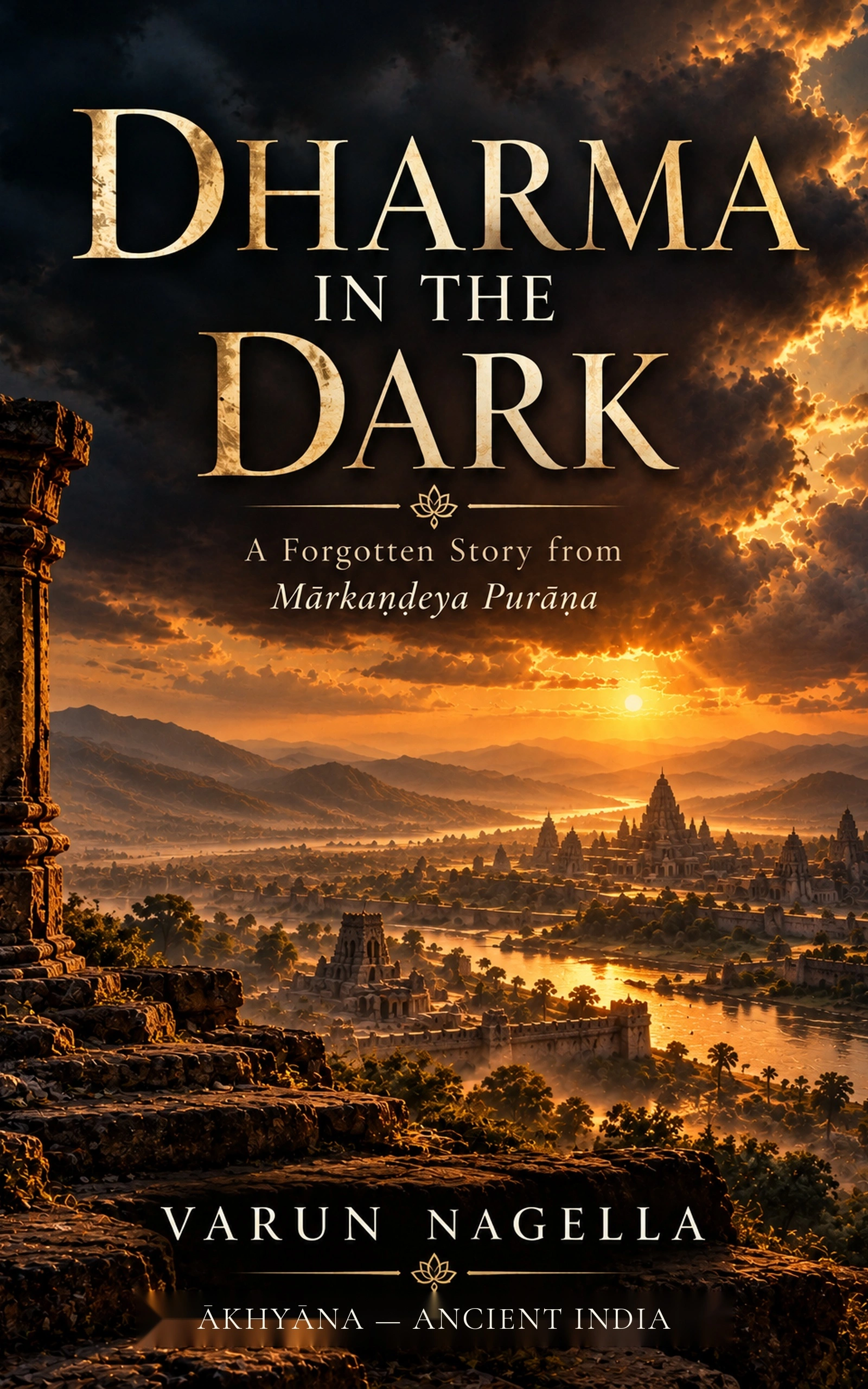
Dharma In The Dark
A righteous king is forced to confront the human cost of decisions he believed were necessary.
About the Book
What does a good man do when he discovers that goodness did not prevent him from causing suffering he could not see?
Vipaścit, king of Videha, has spent his life trying to answer the demands of dharma. He has learned to show mercy without surrendering authority, to choose necessity when kindness alone cannot protect a kingdom, and to carry the burdens of war, succession, and rule as though responsibility itself could be mastered.
But a life of good intentions does not make a man incapable of causing harm.
Inspired by the story of Vipaścit preserved in the Mārkaṇḍeya Purāṇa, Dharma in the Dark follows an imagined lifetime between the brief moments recorded in the ancient tradition: the harvests and councils, battles and political decisions, marriage and succession, aging and death, and the journey beyond the world of the living.
There, Vipaścit encounters something more difficult than punishment.
He encounters the people who lived on the other side of his choices.
A forgotten soldier. A defeated king. Men who carried the cost of policies made far from their homes. Souls who do not ask whether he meant well. They remember what happened.
As Vipaścit moves deeper into Naraka, the question changes. It is no longer whether he was a good king.
It is whether goodness without complete knowledge can ever be enough.
A Story About Consequence
Dharma in the Dark explores the distance between intention and consequence — and the uncomfortable possibility that a person may act with sincerity, compassion, and conviction while remaining blind to the suffering created by those choices.
It is a novel about kingship and responsibility, marriage and succession, mercy and violence, memory and the limits of human knowledge.
The ancient tradition provides the foundation.
The life between its known moments belongs to literary imagination.
More from ĀKHYĀNA