Coming Soon
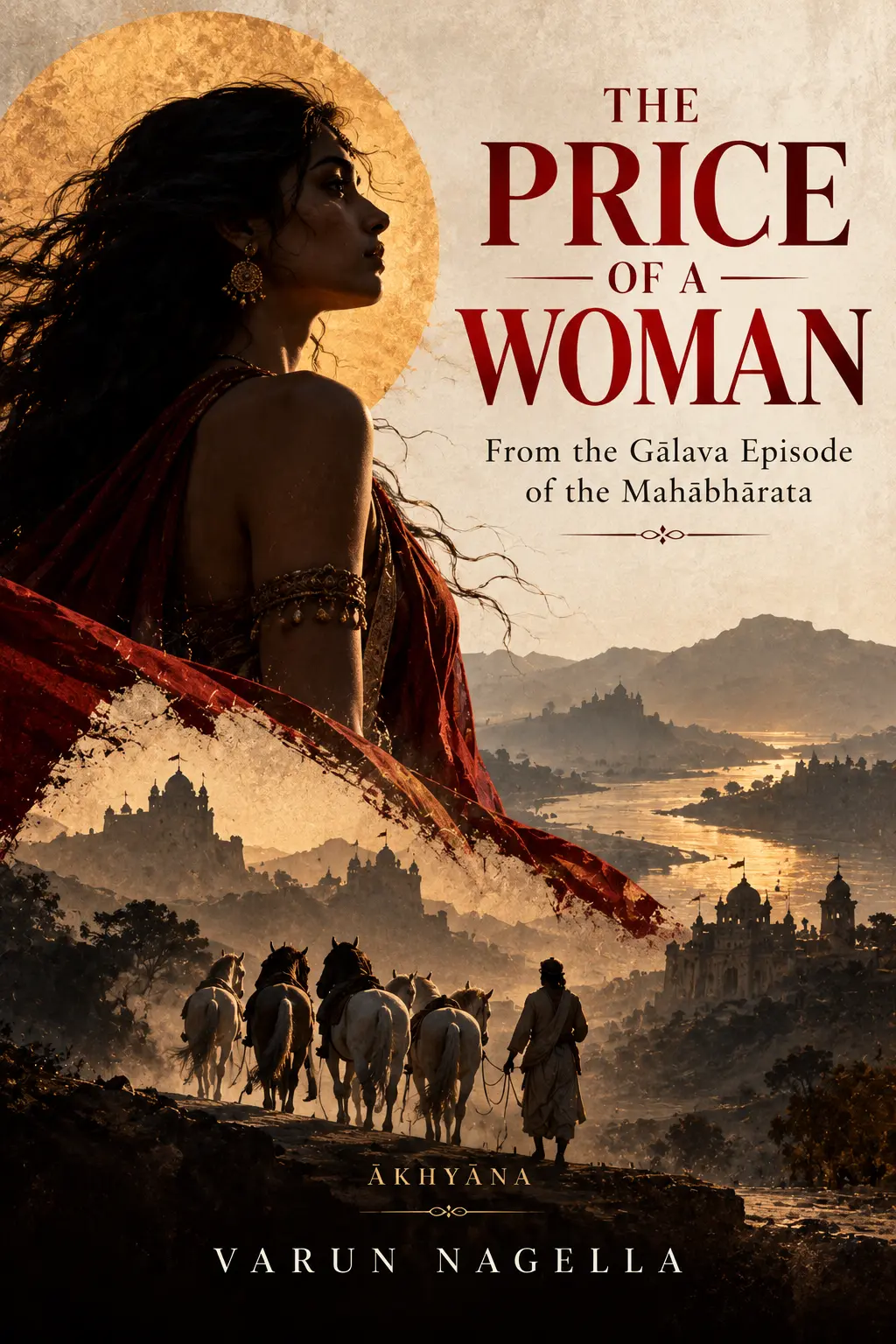
The Price of a Woman
A literary novel about a woman whose life becomes the price of another man's debt—and the journey toward reclaiming a choice that was never truly hers.
About the Book
The Price of a Woman reimagines the story of Mādhavī from the Gālava episode of the Mahābhārata.
When the young ascetic Gālava vows to fulfil an impossible debt to his teacher Viśvāmitra, he discovers that the price of his promise cannot be paid with devotion alone. King Yayāti offers him his daughter Mādhavī, a woman whose extraordinary boon allows her to bear sons for kings and return to her former state.
What begins as a solution to a man’s debt becomes a journey through kingdoms, marriages, motherhood, separation and sacrifice.
But the ancient story leaves much unsaid.
What did Mādhavī feel each time she was given away? What did motherhood mean when her children belonged to other kingdoms? And what happens when a woman who has spent her life fulfilling the expectations of others finally asks what remains if she chooses for herself?
Rooted in the Mahābhārata and expanded through literary imagination, The Price of a Woman enters the silences surrounding Mādhavī’s story to explore duty, love, possession, motherhood and choice.
This is not a translation of the epic, nor a reconstruction of its historical world. It is a work of literary fiction built upon an ancient narrative, imagining the human life within the spaces the traditional account leaves unexplored.
The ancient tradition provides the foundation. The life between its known moments belongs to literary imagination.
Source
The novel is based on the Mahābhārata, specifically the Udyoga Parva, within the narrative concerning Gālava.
The traditional account provides the essential circumstances of Mādhavī’s story: Gālava’s extraordinary guru-dakṣiṇā, his search for the required horses, his encounter with King Yayāti and Mādhavī, the kings who receive her, the sons born from those unions, her return to her father, and her eventual withdrawal from the world of kings.
The interior thoughts, dialogue, emotional responses, relationships, atmosphere, connective narrative and detailed psychological development in this novel are the author’s literary creation and expansion.
More from ĀKHYĀNA