Coming Soon
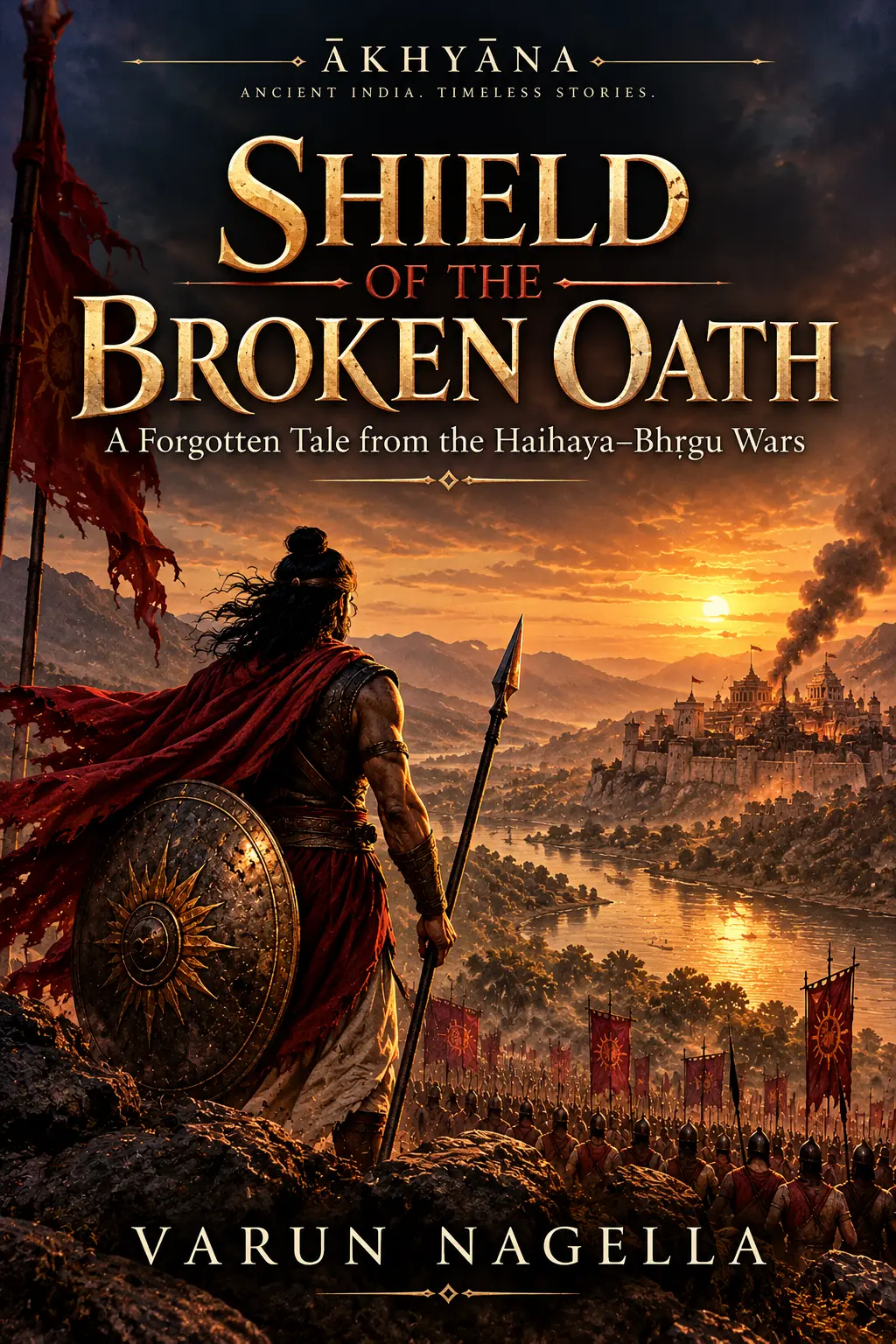
Shield of the Broken Oath
A historical novel about war, neutrality, betrayal, and a master-at-arms forced to choose between the oath he swore and the people he must protect.
About the Book
Shield of the Broken Oath is a historical novel set in the valley of Bhargava, a community that has survived for generations by refusing to belong to any kingdom.
Its people make weapons for kings, but swear allegiance to neither throne. At the centre of this tradition stands Karkash, the valley’s master-at-arms, who has spent years believing that neutrality is the only way to preserve both the valley and his honour.
Then an army arrives.
Led by the formidable Haihaya general Vrishasena, the invading force does not come merely to conquer Bhargava. It comes to dismantle the things that have allowed the valley to survive independently—its roads, its stores, its forge, its people, and the neutrality that has protected them for generations.
Karkash knows what war costs. He has seen men die for promises made by rulers who never stand beside them. He has built his life around refusing to let another king’s war become his own.
But war does not always permit a man the luxury of remaining neutral.
When betrayal opens the valley from within, the defenders are struck where they are weakest. The walls become targets. The forge becomes a battlefield. Villagers become soldiers.
And every decision Karkash makes saves one life while placing another at risk.
As the siege tightens, the valley begins to fracture.
Shrenik, once trusted, betrays the very people who depended upon him. Devaki challenges Karkash’s rigid understanding of duty, forcing him to see that defending a place means more than defending its walls. Jwala and Vira fight a war in which courage alone is never enough. And beside the forge, the aging Ugran and the young apprentice Bala embody the question Karkash has spent his life avoiding:
What does a man leave behind when the oath that defined his life is no longer enough?
The final battle will take Karkash beyond the walls and into the heart of the enemy’s command, where he will face Vrishasena not simply as a soldier facing his enemy, but as a man confronting everything he once believed about honour, duty, and allegiance.
He may break the shield.
He may break the oath.
But he must decide what remains when both are gone.
A Story About Honour and Duty
Shield of the Broken Oath explores the space between neutrality and responsibility, honour and survival, allegiance and duty.
At its centre is a question that becomes increasingly difficult for Karkash to escape:
What happens when the oath you swore to protect others begins to prevent you from protecting them?
For Karkash, neutrality has always been a form of honour. It has allowed Bhargava to survive while kingdoms rise and fall around it.
But neutrality has a limit.
When the valley itself becomes the target, refusing to choose a side may no longer be the same as refusing to participate in war.
The novel follows Karkash through that transformation—from a man determined to preserve an oath to a man forced to decide what that oath was truly meant to protect.
The shield is not merely a weapon.
The oath is not merely a promise.
Both are tested when survival demands a different kind of courage.
Source & Literary Approach
Shield of the Broken Oath is a work of historical fiction built around the fictional valley of Bhargava, its people, its forge, and the conflict that threatens its independence.
The novel uses a historical Indian setting and draws upon the world of ancient warfare, weapons-making, fortified settlements, martial duty, and competing kingdoms as the foundation for its fictional narrative.
The characters, relationships, conversations, interior lives, battles, political circumstances, and narrative events are created or imaginatively rendered for the purposes of the novel.
This is a work of historical fiction, not a historical reconstruction or a documentary account.
The historical world provides the foundation.
The lives, choices, conflicts, and human consequences within it belong to the novel.
More from ĀKHYĀNA